 Reader Picks
Six Hundred and One Reviews, and a Gel Pack You Drink Without WaterThe seller's page counts 601 of them, an average of 4.6 stars, and a buyer mark on every one I read. I set that number beside the thirteen lines on the panel, the trial behind each line, and the thirty-day return terms, in that order.
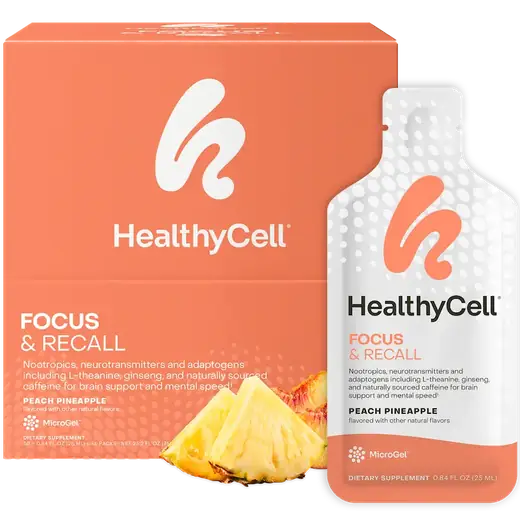
Focus & Recall is a 25-milliliter pouch of flavored gel from HealthyCell, a company in Mount Pleasant, South Carolina: thirteen lines on the panel, 40 milligrams of caffeine, a box of thirty, and more public reviews than anything else that has reached this desk. I read what a number that size can honestly tell a man and what it cannot, and then I read every line of the panel against the trial that tested it.

This is a paid advertisement. Sponsored by Life Science Institute LLC (HealthyCell).

Perry Ellwood is the pen name of this desk.
Everything on this page about the gel comes from the seller's own label, product page, questions page and return terms, read on September 20, 2026.
The customers quoted further down are real, and their reviews are public on the seller's product page.
The small portraits beside those reviews are illustrations, not the reviewers, and I have never met any of them.
I buy most things the way you probably do.
I look at the number of reviews, I look at the average, and if both are good I stop looking.
This box broke that habit.
Six hundred and one reviews and an average of 4.6 stars is the largest pile of public opinion that has ever landed on this desk, and it is still not a trial.
Six hundred and one people liked it. Nobody measured whether it works.
Focus & Recall is a single-serving gel from HealthyCell, a company in Mount Pleasant, South Carolina.
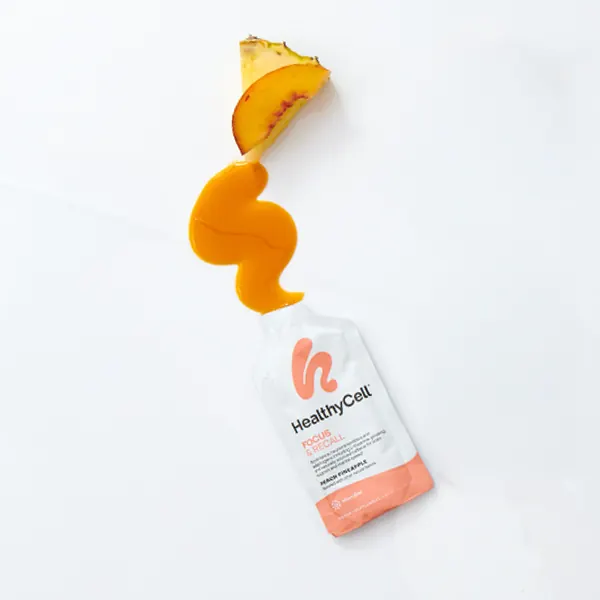
It comes thirty pouches to a box, one a day, and you tear a corner and squeeze it straight into your mouth.
No water, no glass, no spoon.
That is the whole appeal of the format, and it is a real one if you travel or you work away from a kitchen.
So I read this box in the order a careful man would: the reviews first, because that is what sold it; then the panel, line by line, against the trial behind each line; then the return terms, because that is the only promise the seller actually makes.
One pouch a day, by the label. Every figure on this page is for one pouch of 25 milliliters.
What I found is a real caffeine dose, one pair of ingredients at almost exactly the doses of a small study, several lines well under the doses their trials used, one line that belongs at the pharmacy counter, and a thirty-day window that runs out on the same morning as the box.
One more thing before the first entry, because most of you got here from one of our own advertisements.
Those ads talk about a boxed cereal, three foods, three drinks and three words a man is supposed to be able to say.
None of that is in the pouch, and I am not going to pretend it is.
It is on this page, in its place: the eleventh entry, with the studies, and the honest version of every headline we run is in the guide linked at the foot.
Entry one · The numberWhat Six Hundred and One Reviews Can Tell a Man, and What They Cannot
Start with the thing that made you click.
The seller's page counts 601 reviews and an average of 4.6 stars, and every one I read carries the seller's mark for a confirmed purchase.
That is not nothing.
A pile that size, on a product that costs real money and arrives by post, tells you several useful things at once.
- People are actually buying it, in numbers, and the seller leaves the low ratings up where you can read them.
- The taste and the texture are not a problem for most buyers, which matters for something you squeeze into your mouth.
- The box arrives, the pouches are not leaking, and the company answers its post.
- Enough people reorder that a 4.6 average survives 601 opinions.
Now the other half, and it is the half the number cannot cover.
A review is one person, with no comparison, remembering how a morning felt.
Nobody who wrote those 601 reviews had a second, identical box with nothing in it.
Nobody was assigned at random, and nobody was counting anything except their own impression.
Here is the comparison I keep coming back to.
One of the ingredients in this pouch, phosphatidylserine, was tested in 78 people for six months, with half of them taking a look-alike that contained nothing. [1]
Seventy-eight people with a comparison group told the researchers more than 601 people without one.
That is the uncomfortable arithmetic of reviews, and it does not improve when the pile gets bigger.
There is a second thing the pile cannot separate.
This pouch carries 40 milligrams of caffeine, and caffeine makes most people more alert for a couple of hours. [2]
So when a buyer writes that they felt sharper within half an hour, they are describing something real.
They just cannot tell you which of the thirteen lines on the panel did it, and neither can I from a review.
Six hundred and one reviews prove that a lot of men liked a peach-flavored gel with caffeine in it. They cannot tell you what the other twelve lines did, because nobody in those 601 had anything to compare against.
Entry two · The pouchTwenty-Five Milliliters, Thirty to a Box, and Two Grams of Sugar
This is what arrives.
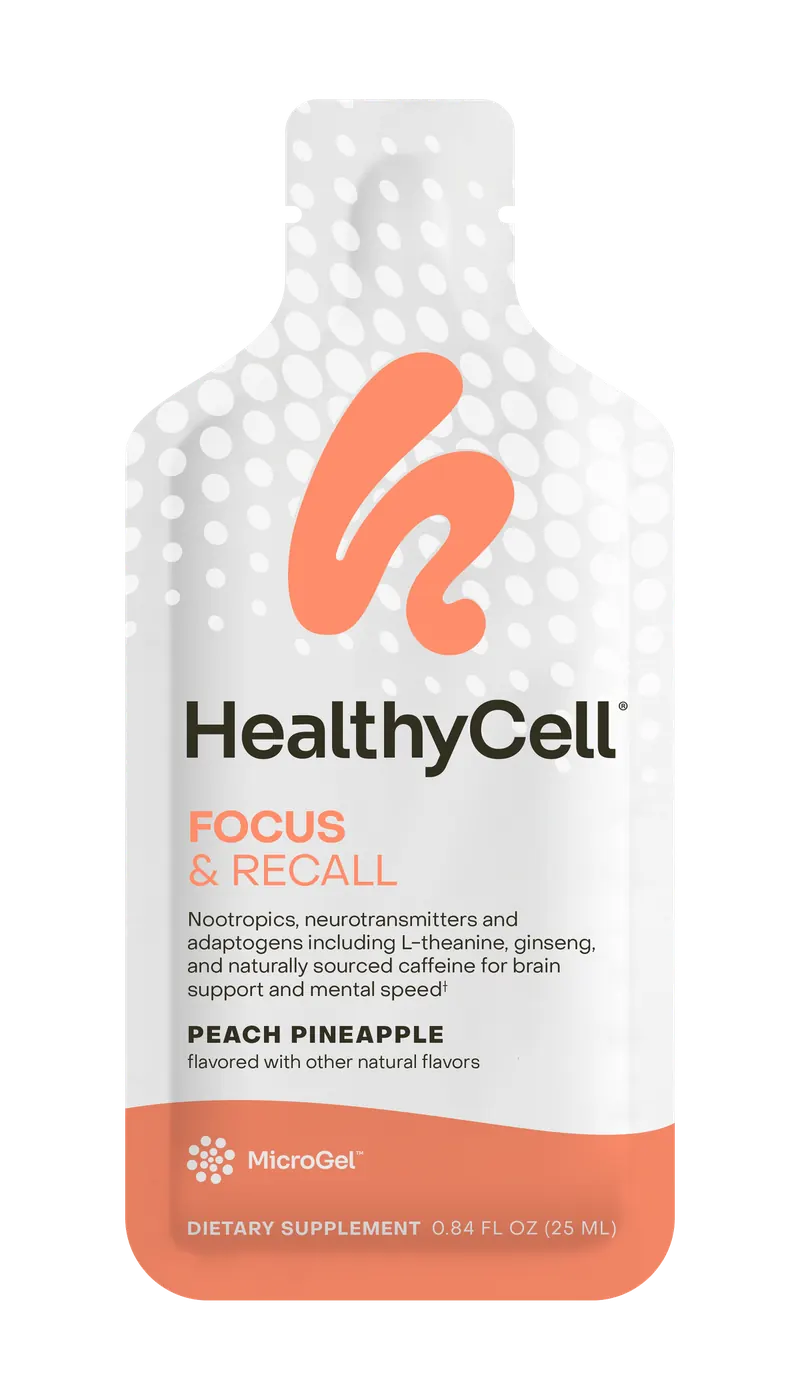
A white carton with thirty flat foil pouches inside, each holding 25 milliliters of a peach-and-pineapple gel.
The seller's own phrase for it is mix it, squeeze it, blend it.
The directions are as short as directions get.
One pouch a day for adults, torn at the corner, taken on its own or stirred into a glass.
The nutrition lines are worth a moment, because a gel has to be made of something.
Thirty calories, six grams of carbohydrate, two grams of sugars from apple juice concentrate, and ten milligrams of sodium.
Two grams of added sugar is about half a teaspoon, which is nothing next to a soft drink and is not nothing if you are counting.
The rest of the gel is water, vegetable glycerin, fruit acids, pectin, xanthan gum, inulin, a stevia leaf extract and a little salt.
The seller's questions page adds the two lines that matter most for planning your morning.
A man should expect to feel something within half an hour that lasts two to three hours, and the box is meant to be taken every day for the long term.
Half an hour on, two or three hours long.
That is the shape of a caffeine dose, and we will come back to it.
Entry three · The best pair on the panelForty Milligrams of Caffeine and a Hundred of Theanine, Which Is Almost Exactly a Study
Of the thirteen lines, two of them arrive at a dose a study actually used, and they arrive together.
The caffeine first, because it is the line whose effect nobody argues about.
Forty milligrams, which the label attributes to green coffee beans, and which is roughly half a mug of ordinary coffee.
The Food and Drug Administration puts a 12-ounce cup of brewed coffee at anywhere from 113 to 247 milligrams, and cites 400 milligrams a day as an amount not generally tied to trouble in most healthy adults. [3]
Europe's food safety agency reached the same daily figure, puts 200 milligrams as a single serving, and says plainly that caffeine in moderate amounts makes people more alert and less sleepy. [2]

So count this pouch with your coffee, not instead of it.
Two mugs before noon plus a pouch puts you comfortably in the middle of the daily figure. [3]
Now the second half of the pair.
L-theanine is an amino acid found almost only in tea leaves, and this pouch carries 100 milligrams of it, several cups' worth.
Here is why the two together are the fairest thing on this label.
In a small study, 27 volunteers took 50 milligrams of caffeine with 100 of L-theanine, and an hour later they were faster and more accurate on a task that switched attention back and forth, and less thrown by distracting information in a memory task. [4]
Forty and a hundred is very close to fifty and a hundred, and it is the only line on this panel where the pouch and a published dose almost meet.
The study was a single dose in 27 people, run by researchers working for a tea company, and the summary does not give their ages. [4]
Theanine on its own has been looked at twice more, and both are worth your time.
In Japanese adults aged 50 to 69, a single dose went with faster reactions on an attention task and fewer errors on a short-term memory task, though the summary never states the dose. [5]
The other used 200 milligrams a day for four weeks in 30 adults averaging 48, and their word-fluency and planning scores rose. [6]
That is twice this pouch, and two of the authors worked for the company that supplied the theanine. [6]
Caffeine at half a mug and theanine at a hundred milligrams: the one combination on this panel that lands near a real study's dose. Its measured effect was on attention within the hour, not on memory over a year.
Entry four · The two largest numbersFive Hundred Milligrams of Taurine and Three Hundred of Tyrosine
The two biggest figures on the panel are also the two I would weigh least.
Taurine comes first at 500 milligrams, and it is the single largest line in the pouch.
It is an amino acid your body already carries in quantity, and you meet it in shellfish, meat and most energy drinks.
The evidence is short and clear, which is refreshing.
A 2025 review pooled seven randomized trials in 402 people and found no significant effect of taurine on thinking scores, on its own or alongside exercise. [7]
The biggest number on the panel is the one with a null result behind it.
That is not a scandal, and the company is not hiding it.
It is simply a large, cheap, harmless line that the best available summary says does nothing for this. [7]
Tyrosine is next at 300 milligrams, and it is more interesting.
It is a building block for two of the body's messengers, and a 2015 review concluded that supplementing it seems to help performance in short, demanding situations when those messengers have been temporarily run down. [8]
Outside those situations, the same review says its usefulness looks limited, and most of the work was done in young adults without the doses reported. [8]
So tyrosine may be worth something on a bad night or a long drive, and probably nothing on an ordinary Tuesday.
Eight hundred milligrams of the pouch is taurine and tyrosine. The pooled evidence for taurine is a null result; tyrosine looks like a line for hard days, not for every day.
Entry five · The rootTwo Hundred Milligrams of Ginseng at One Percent, Against the Four Percent of the Trials
This is the line where a percentage does all the work, and where most labels hope you will not look.
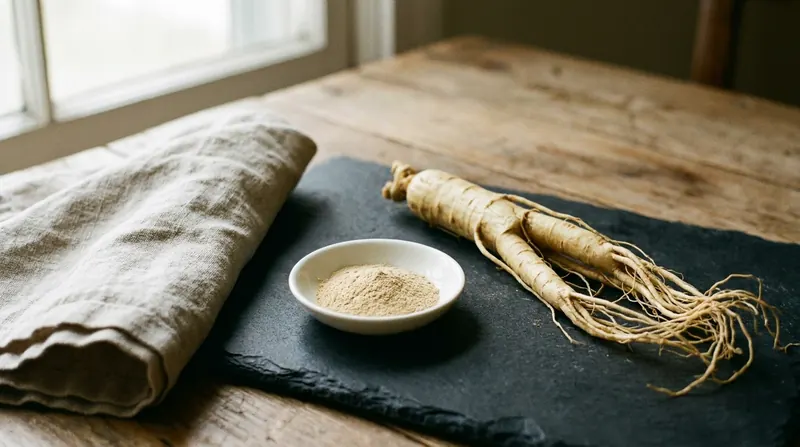
The panel lists 200 milligrams of Panax ginseng root extract, standardized to one percent total ginsenosides.
Ginsenosides are the compounds the research is about, so one percent of 200 milligrams is two milligrams of the part that matters.
The two studies most often attached to ginseng used a different extract.
Both used G115, which is standardized to four percent, at 200 or 400 milligrams a day. [9] [10]
Four percent of 200 milligrams is eight.
So this pouch carries a quarter of the ginsenosides of the lower dose in those studies, and an eighth of the higher one.
It is worth saying what those studies actually found, because it was modest.
In 30 healthy young adults, a single 200-milligram dose went with better performance on a subtraction task during an hour of sustained mental work and with less self-rated tiredness. [10]
The follow-up gave 30 young adults eight days of 200 or 400 milligrams, and only the 400 improved mental arithmetic; the 200 actually slowed one task down. [9]
Both were in people averaging 23 years old, which is about as far from this page's reader as a study can get.
Ginseng at a quarter of the ginsenosides of the weaker of two small studies, both run in adults around 23. The name on the panel is real; the dose behind it is not the dose anyone tested.
Entry six · The phospholipidA Hundred Milligrams of Phosphatidylserine, and the Trial That Came Back Empty
This is the line I mentioned at the start, and the reason I keep bringing up comparison groups.
Phosphatidylserine is a fat that sits in the membrane of every cell you own, and this pouch carries 100 milligrams of it, drawn from sunflower lecithin.
It has the most honest-looking trial on the whole panel, and the trial did not go the company's way.
Seventy-eight Japanese adults aged 50 to 69, all of them with memory complaints, took 100 milligrams a day, 300 milligrams a day, or a look-alike with nothing in it, for six months. [1]
Scores rose in all three groups, including the group taking nothing, and the difference between them was not significant. [1]
Everybody improved. That is what a comparison group is for.
There was one smaller finding, and it is fair to report it.
Among the people who started with the lowest scores, the phosphatidylserine groups did improve from their own starting point, mostly on remembering a list of words after a delay. [1]
That is a subgroup result inside a trial whose main answer was no, in a study run by the company that makes the ingredient. [1]
A hundred milligrams a day for six months is exactly what this pouch delivers, and it is exactly the dose that came back empty.
The one line on this panel tested at this dose, for six months, against a comparison group, in adults the age of this page's readers. The main result was no difference.
Entry seven · The three smallest linesThe Club Moss, the Turmeric and the Plant Oil
Three lines left, and between them they weigh less than the taurine alone.
Start with the smallest number on the panel, because it is the one I would take to a pharmacist before the first pouch.
Fifty micrograms of huperzine A, drawn from a club moss called Huperzia serrata.
What it does is not mysterious, and it is not like the rest of this box.
It slows the enzyme that breaks down acetylcholine, one of the chemical messengers between nerve cells.
A small study gave healthy adults single doses of 100 or 200 micrograms and confirmed that slowdown in the blood. [11]
The 200-microgram dose kept recall steady across sessions, and neither dose improved overall performance. [11]
This pouch carries half of the lower of those two doses, and the study's own result at that end was a change in an enzyme, not a better score. [11]
Some things a man takes every day act on that same enzyme, in one direction or the other, so put this box in the bag with everything else and let the pharmacist read the panel.

Turmeric next, at 100 milligrams of curcuminoids.
The trial people cite for this one ran eighteen months in 40 adults aged 51 to 84 and used a high-absorption form at 90 milligrams twice a day, which is 180 a day. [12]
That group did better on verbal memory, visual memory and attention than the group taking nothing. [12]
This pouch has a little over half that daily amount, in a plain curcuminoid extract rather than the patented high-absorption one the trial used. [12]
The federal fact sheet on turmeric is blunter than either of us.
It says we do not know enough to conclude whether turmeric or curcumin is helpful for any health purpose. [13]
Last, the plant oil.
A hundred milligrams of Ahiflower seed oil, which is 65 percent short-chain omega-3, so about 65 milligrams of the omega-3 part.
Its trial gave 88 healthy adults 9.7 millilitres a day for 28 days and measured a dose-dependent rise in omega-3 levels in the blood, though not in DHA. [14]
A hundred milligrams is about a tenth of a millilitre, which is roughly a hundredth of what that trial poured. [14]
And that trial measured a blood level, not a memory.
A line that small, against a dose that large, is a name on a panel.
Huperzine at half the lower study dose and the one line to name at the pharmacy counter; turmeric at a little over half its trial's daily amount in a weaker form; and a plant oil at about a hundredth of the amount its trial used.
Entry eight · The vitaminsThree B Lines, Big Percentages, and the Review That Settled Them
The three lines the panel prints with the biggest percentages are also the three with the least to do with the question.
Vitamin B6 at 4.3 milligrams is 250 percent of the Daily Value, folate at 400 micrograms is 100 percent, and vitamin B12 at 4.8 micrograms is 200 percent.
Those percentages look imposing and are, in absolute terms, small and ordinary.
B6 at 4.3 milligrams sits far under the government's ceiling of 100 milligrams a day, which is the figure worth knowing if you also take a multivitamin or a B complex. [15]
B12 has no ceiling at all, because it is very hard to take too much, and somewhere between three and forty-three percent of older adults living at home are short of it depending on how you count. [16]
With age the stomach pulls less B12 out of food, and the loose form in a supplement does not need the same help. [16]
So the B12 line is a reasonable guess at a real problem, and a blood test is the only way to find out whether it is your problem.
What the B vitamins will not do is sharpen a man who is not short of them.
The largest review of the question pooled fourteen trials in 27,882 adults with healthy thinking and concluded that B-vitamin supplements probably have little or no effect on it at any point up to five years. [17]
Ordinary vitamins at ordinary amounts, sensible if a blood test says you are short and close to irrelevant if it does not.
Entry nine · What four of the 601 wroteThe Reviews I Would Actually Read, and the One Line in Them Worth Keeping
I read a long way down the pile and kept four.
They are public on the seller's product page, each carries the seller's purchase mark, and the small portraits beside them are illustrations rather than the people.

Great vitamins. I can tell a real difference in my cognition when I take these gel packs.

Taste is good. I think it helps? With L-theanine and caffeine and other components, I do think that it helps me feel more focused and alert. I don't take this daily, but I do take it a few times a week, when I'm at work or traveling.

I would've kept subscribing, but I cannot consistently afford to pay for it. Could tell a difference working nights. Toward the wee hours of the morning, I could really tell that my focus and recall were better.

Taste great. Good stuff.
Read the second one again, because it is the most useful sentence in the whole pile.
A buyer names the theanine and the caffeine, says she thinks it helps, puts a question mark on her own claim, and takes it a few times a week when she is working or travelling.
That is a person describing exactly what this panel is best equipped to do.
She has written, without meaning to, the honest version of this product: the pair that lands near a study, used on the days that are hard.
The third is useful in a different way.
A buyer who liked it stopped because of the price, which is a fact about your wallet that no average out of 601 will ever show you.
Four real buyers, all with the seller's purchase mark. The most valuable one is the one with a question mark in it.
Entry ten · The thirty-day windowThirty Pouches, One a Day, and a Promise That Ends on the Same Morning
Now the part that changed how I would buy this box, and the part no review mentions.
The seller makes one promise, and it is short.
If the box does not do what you hoped, tell them within thirty days of the order, send the product back with the order number, and they refund you within one to seven business days of receiving it.
Read those terms slowly, because there are four conditions hiding in one sentence.
The clock starts at the order, not at the first pouch; you have to tell them inside the window; you have to send the product back; and the postage back is yours.

Now do the arithmetic, because the box is built to thirty and the window is thirty.
If you order on the first, the box arrives around the third, and you start on the fourth, your last pouch is the thirty-third.
By the morning you finally know whether it did anything, the window has closed and the box is empty, so there is nothing left to send back.
That is not a trap, and I do not think it was designed as one. It is simply what happens when a thirty-day box meets a thirty-day window.
Decide by day twenty, with ten pouches still in the drawer.
So here is the only sensible way to buy this box, and it costs nothing to follow.
Write the order date on the carton flap the day it arrives, and mark the twentieth day on your calendar.
On that twentieth morning you will have taken twenty pouches, which is a longer run than most of what this desk reviews, and you will still have ten in the drawer.
Ten pouches is a product you can post back, and a decision you can still make.

One more line from the seller's own pages, since we are being exact.
Shipping inside the United States is at no charge on single orders of ninety dollars or more and on any subscription; below that a rate appears at checkout, and orders outside the country go through a separate page.
Tell them inside thirty days, send the product back with the order number, and pay the postage. A thirty-pouch box against a thirty-day window means the decision has to come early.
Entry eleven · The bowl and the cupThe Cereal, the Three Drinks, the Three Foods and the Word Test From Our Own Advertisements
Our advertisements have been saying, in one version or another, that a boxed cereal, three foods and three drinks have something to do with memory, and that there are three words or phrases a man ought to be able to say.
You are owed the honest version in one place, so here it is.

Start with the bowl.
A frosted, honey-coated or chocolate cereal is mostly refined starch and added sugar, and a serving can carry more sugar than a biscuit.
No cereal ages the brain faster than time.
Nobody has measured any such thing, and that phrase was written to be clicked.
What the research actually found is duller and worth more.
In a Brazilian study of 10,775 adults followed for eight years, the people who ate the most ultra-processed food lost ground on thinking tests about a quarter faster than the people who ate the least. [18]
That is an association across a population, not a sentence on your bowl. [18]
The three drinks.
The evening drink in our advertisement is alcohol, and it has the strongest case behind it: in 550 British civil servants followed for thirty years, the more a person drank the faster their word-fluency scores fell, and light drinkers had no edge over people who did not drink at all. [19]
The second is sugar in a glass: soda, sweetened tea and the tall flavored coffee from the counter.
They sit on the same ultra-processed shelf as the sweet cereal, and that is the honest case against them. [18]
The third, in one of our headlines, was coffee.
That was our worst headline.
Plain black coffee and plain tea are not the drinks any of those studies were about.
Keep your coffee, and count this pouch's forty milligrams along with it. [3]
The three foods.
Processed meat, fried food and the white-flour shelf: pastries, packaged cakes, white bread.
Our advertisement says just stop eating these three.
The research says something slower.
In a three-year trial of 604 older adults, one group ate the MIND pattern of vegetables, berries, nuts, whole grains, beans, fish and olive oil, and the other ate its usual food with slightly fewer calories; both groups' thinking scores rose by about the same amount. [20]
That is a pattern over years, not a list of three, and even the eating plan built for it did not beat plain care with what you eat. [20]
Less sugar in the bowl and the glass.
Less alcohol in the evening.
Keep the coffee.
Eat more like the Mediterranean shelf and less like the vending machine.
The three words, or the three phrases.
There is no such list.
What our advertisement borrowed from is the short, scored check that clinicians have given in person since the 1970s: the date and the place, a few words to hold and give back a minute later, a sum, naming, copying a drawing.
It is read against your age and your schooling by someone trained to do it, and a low score is a reason for a proper look, not a verdict.
Stumbling on a word when you are tired or being timed means nothing on its own.
If the worry behind the click is real, that is fifteen minutes with your own clinician.
And the advertisement about the things some men take every day.
That one sits closest to real research, and it is the one an advertisement has no business acting on.
Some of what a man takes daily, including a few things sold over the counter for allergies and for the night, are on the lists pharmacists check for people over 65.
Do not stop or change any of it because of an advertisement, ours included.
Put everything you take in one bag, this box included, and take it to the pharmacist.
Ask one question: is anything here a poor choice at my age, and does anything here argue with the club-moss line on this panel?
So if you clicked on the cereal, here is where it went: onto a kitchen counter beside a small foil pouch, where the real answer was always a plainer bowl, a fillet of fish, and the coffee you already had.
Entry twelve · What it isn'tSix Things Six Hundred and One Reviews Do Not Buy You
- A trial of this pouch. Nobody has tested the thirteen lines together, in anybody, at any age.
- A comparison group. Not one of the 601 had a second box with nothing in it.
- The ginseng of the studies. Two milligrams of ginsenosides against the eight in the weaker of the two.
- A result for the phosphatidylserine. Its six-month trial at exactly this dose came back with no difference.
- A reason to skip the pharmacy counter. The club-moss line acts on a body enzyme and should be read by someone who knows what else you take.
- A thirty-day decision. The window closes on the morning the box does, so the real deadline is day twenty.
If that list annoys you, I would rather you were annoyed now than on the thirty-first morning with an empty carton and nothing to post back.
Entry thirteen · The routineIf You Do Buy It: One Box, the Pharmacist First, Before Lunch, and a Date on the Flap
- Buy one box of thirty. Not two, and not the subscription, until you have finished the first.
- Take the carton to the pharmacist before the first pouch, with everything else you take. Ask about the club-moss line by name.
- Write the order date on the carton flap the day it arrives, and mark day twenty on the calendar.
- One pouch a day, before lunch. It carries forty milligrams of caffeine and the seller says its effect lasts two to three hours.
- Count it with your coffee. Half a mug's worth, added to what is already in your cup.
- Write one line a day in a notebook. Not sharper or foggier, but what you were doing at ten in the morning and how it went.
- On day twenty, read those twenty lines beside the week before you started. That is the only trial of this box you will ever get.

Look at that list the way I do.
Six of the seven things on it cost nothing at all.
This is worth a look if:
- You want the caffeine-and-theanine pair in something you can carry in a jacket pocket without water.
- You have read that two lines land near a study's dose, and that several do not.
- You will take the carton to the pharmacist before the first pouch and ask about the club moss.
- You will write the date on the flap and decide by day twenty, with pouches still in the box.
Give it a miss if:
- You take something daily that the pharmacist says argues with the club-moss line.
- You are sensitive to caffeine, or you already drink three mugs before noon.
- You wanted the doses the trials used. On this panel, two lines get close and the rest do not.
- You were buying it because of the 601. That number is about how people felt, not about what the panel did.
Entry fourteen · Where it's soldFrom a Company in Mount Pleasant, South Carolina, With a Street Address and a Telephone
The box is sold directly by the company that makes it, and that is the only place this page links to.
The seller is Life Science Institute LLC, trading as HealthyCell, of Mount Pleasant, South Carolina, and it publishes a street address, a telephone number and a support email.
That is more contact detail than most of what reaches this desk, and it is the minimum I would want before posting a carton back to anybody.
The price is the one on the seller's page on the day you look, and this page prints none, because a subscription and a multi-box order carry different figures.
Look at it before you click, and look at the shipping line for your address.
Buy one box.
Write the date on the flap, and let the pharmacist read the panel first.
Twenty mornings in a notebook beat six hundred and one strangers.
Every line of the panel, with its plain English name, its amount per pouch, the trial behind it and who paid for that trial, is written out in the ingredient and advertising guide linked at the foot of this page.
It also explains the club-moss line for the pharmacist, and says which of our own headlines this box does and does not support.
Where to get it
A 25-milliliter gel pack you squeeze into your mouth or a glass, with thirteen ingredients, 40 milligrams of caffeine and a peach-pineapple taste.
CHECK AVAILABILITYSold by Life Science Institute LLC (HealthyCell), Mount Pleasant, South Carolina · thirty 25 ml pouches · one a day by the label · 40 mg of caffeine per pouch · thirty-day return terms, postage back at your cost
QuestionsWhat Readers Ask Me Before the First Pouch
Questions readers ask
Is this medicine?
No. It is a dietary supplement: a flavored gel with caffeine, three B vitamins and nine other ingredients, made and sold by a company in South Carolina.
Its carton carries the standard sentence every American supplement carries, the one that says the Food and Drug Administration has not evaluated its claims.
Six hundred and one reviews is a lot. Isn't that evidence?
It is evidence that a lot of people bought it and most of them were pleased. It is not evidence that the panel does anything, because not one of those buyers had a second box with nothing in it to compare against. [1]
The pouch also carries forty milligrams of caffeine, which makes most people more alert for a couple of hours, so a good review cannot separate the caffeine from the other twelve lines. [2]
How much caffeine is in it?
Forty milligrams a pouch, about half a mug of brewed coffee. A 12-ounce cup runs from 113 to 247 milligrams, and 400 milligrams a day is the figure the Food and Drug Administration cites for most healthy adults. [3]
Which lines are at the dose a study used?
Two of them, and they work as a pair. The caffeine at forty and the theanine at a hundred are close to the fifty and a hundred of a small study that measured attention within the hour. [4]
The phosphatidylserine is also at its trial's dose, and that trial found no difference against a look-alike over six months. [1]
What is the club-moss line, and why the pharmacist?
It is fifty micrograms of huperzine A, which slows the enzyme that breaks down acetylcholine, a messenger between nerve cells. [11]
Some things a man takes every day act on that same enzyme, in one direction or the other, so let the pharmacist read the panel before the first pouch.
Do I need water with it?
No. You tear the corner and take the gel straight, or stir it into a glass if you prefer.
That is the honest advantage of the format.
How do the returns work?
Tell the seller inside thirty days of the order, send the product back with the order number, and they refund you within one to seven business days of receiving it. The postage back is yours.
Because the box holds thirty pouches and the window is thirty days, decide by about day twenty, while you still have pouches to send back.
Can I take it every day for months?
The seller says it is designed for long-term daily use. I would still finish one box, read your own twenty lines, and decide before signing up for more.
What about the sugar?
Two grams per pouch, from apple juice concentrate, alongside thirty calories and six grams of carbohydrate. That is about half a teaspoon of sugar.
Your advertisement was about a cereal, or three foods, or three drinks. Where is that on this page?
In the eleventh entry, in full, with the studies. The short version: less sugar in the bowl and the glass, less alcohol in the evening, keep your plain coffee, and eat more like the Mediterranean shelf.
None of it is in the pouch, and the ingredient and advertising guide at the foot goes through every headline we run.
Your advertisement said something about three phrases, or spelling three words. Is there a test I can take?
Not on a screen. The words and phrases come from the short scored check clinicians give in person, read against your age and schooling.
If the worry behind the click is real, ask your own clinician for the proper check. It takes about fifteen minutes.
The short versionEverything Above, in Sixty Seconds
- A 25-millilitre gel pouch from HealthyCell of Mount Pleasant, South Carolina, thirty to a box, one a day, torn at the corner and taken without water.
- Six hundred and one public reviews averaging 4.6 stars, each with the seller's purchase mark: a large, honest pile of opinion, and not one of them had anything to compare against.
- Caffeine at 40 milligrams and theanine at 100 are the fairest pair on the panel, close to the doses of a small attention study. [4] [3] [2]
- Taurine at 500 milligrams is the largest line and has a pooled null result behind it. [7]
- Tyrosine at 300 milligrams looks useful in short demanding spells and limited otherwise. [8]
- Ginseng at 200 milligrams is standardized to one percent, a quarter of the ginsenosides in the weaker of its two small studies. [9] [10]
- Phosphatidylserine at 100 milligrams is exactly its trial's dose, and that six-month trial found no difference. [1]
- Huperzine A at 50 micrograms is half the lower dose of a single-dose study; take the carton to the pharmacist first. [11]
- Turmeric at 100 milligrams of curcuminoids is a little over half its trial's daily amount, in a weaker form, [12] [13] and the plant oil is about a hundredth of its trial's amount. [14]
- Three B vitamins at ordinary amounts; the largest review found little or no effect on thinking in people who are not short. [17] [16] [15]
- Thirty pouches against a thirty-day return window: decide by day twenty, while you still have product to post back.
- The cereal, three drinks, three foods and the word test from our own advertisements, in the eleventh entry: less sugar, less alcohol, keep the coffee, no test on a screen.
The last lineWhat Six Hundred and One Reviews and Thirteen Lines Are Actually Worth
Here is the whole thing in one breath.
The biggest pile of public opinion this desk has seen, which tells you the gel tastes fine, arrives intact and pleases most of the men who buy it.
And thirteen lines on a panel, of which two land near a study's dose, one landed on its dose and missed, and the rest sit well under the amounts anybody tested.
A real forty milligrams of caffeine that will do what caffeine does, a club-moss line that needs two minutes of a pharmacist's time, and a format you can carry in a jacket without a glass of water.
And a thirty-day window that quietly expects you to decide long before the box runs out.
If you are a man who wants the caffeine-and-theanine pair in a pocket, who will show the carton to the pharmacist and write the date on the flap, that is worth one box.
Not because of the 601.
Because you will know which two lines are doing the work, and how far the other eleven sit from the studies with their names on them.
Buy one box, show it to the pharmacist before the first pouch, write the order date on the flap, take one before lunch, count it with your coffee, and write one line a day. Twenty mornings in a notebook will tell you more than six hundred and one strangers can.
Check the current price and availability
A 25-milliliter gel pack you squeeze into your mouth or a glass, with thirteen ingredients, 40 milligrams of caffeine and a peach-pineapple taste.
CHECK AVAILABILITYLife Science Institute LLC (HealthyCell), Mount Pleasant, South Carolina · thirty 25 ml pouches · one a day, before lunch · tell the seller inside thirty days and post the product back at your cost
P.S. If you take one thing from this page, take the two dates.
The order date on the carton flap, the day it arrives.
Day twenty on the calendar, while there are still ten pouches in the drawer.
P.P.S. If the middle of your afternoon has been going sideways for a year, and it goes sideways before the coffee too, talk to your own clinician before you buy anything.
A thirty-pouch box was never going to answer a question that fifteen minutes and a blood test can answer properly.